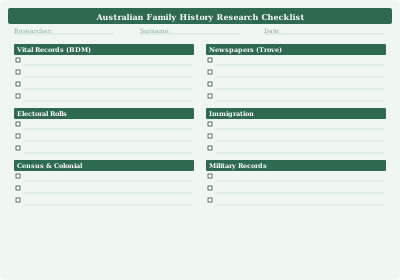
How to Use This Checklist
- Print one checklist per ancestor or family line you are actively researching.
- Write the ancestor's name in the Surname field at the top.
- Tick each box as you search a record source — whether or not you find anything. A negative result is still a result.
- Record your actual findings (what you found, where, and when) on a separate Genealogy Research Log.
- Come back to unticked boxes as your research continues.
About This Checklist
This checklist is designed specifically for Australian family history research and covers the record types that are most productive for tracing Australian ancestry. Unlike generic genealogy checklists, it includes sources specific to Australian records — Trove digitised newspapers, the National Archives of Australia (NAA), convict records, colonial muster rolls, and AIATSIS for researchers with Indigenous Australian family connections.
Australian genealogy research has several distinct characteristics that set it apart from UK or US-based research:
- Civil registration began at different times in each colony. Victoria began registering births, marriages, and deaths in 1853; New South Wales in 1856; Queensland in 1856; South Australia in 1842; Western Australia in 1841; and Tasmania in 1838. Before these dates, church records are often the only formal record.
- Trove is uniquely powerful. Australia has one of the most accessible collections of digitised historical newspapers in the world, available free via Trove. Many Australian genealogy records that no longer exist in original form survive as newspaper notices.
- Convict records cover a large proportion of Australians. An estimated 20% of Australians are descended from transported convicts. Convict records held by the NAA and state archives are detailed and often include physical descriptions, conduct records, and post-transportation life events. See the Convict Ancestry Research Worksheet if this applies to your family.
- Electoral rolls are exceptionally useful. Australia introduced compulsory voter registration early, and federal electoral rolls from 1903 onwards are freely available through the NAA and Ancestry. They allow researchers to track individuals across addresses and time periods.
Record Sources Covered
- Vital Records (BDM). Birth, marriage, and death certificates from state and territory registries. Each registry has an online ordering service.
- Electoral Rolls. Federal electoral rolls 1903 onwards (NAA RecordSearch / Ancestry), state rolls, and colonial muster rolls.
- Census and Colonial Records. 1828 and 1841 NSW Censuses, 1851 Victorian Census, and convict records.
- Church Records. Baptism, marriage, and burial registers held by churches and state archives.
- Trove Newspapers. Birth, marriage, death, and obituary notices, plus inquest and court records in historical newspapers.
- Immigration. Assisted emigration records, ship passenger lists, naturalisation records, and post-1966 passenger cards (NAA).
- Military. WWI and WWII service records (NAA RecordSearch), Boer War records, and medals.
- Other Sources. Cemetery records, probate and wills, land records, AIATSIS for Indigenous family research, and state library / local history collections.
Frequently Asked Questions
What Australian genealogy records are on this checklist?
The checklist covers eight categories: Vital Records (BDM certificates), Electoral Rolls, Census and Colonial Records, Church Records, Trove Newspapers, Immigration Records, Military Records, and Other Sources including cemetery records, probate, and AIATSIS.
What is Trove and why is it on the checklist?
Trove (trove.nla.gov.au) is a free digitised archive from the National Library of Australia. It includes millions of pages of historical newspapers from the 1800s and early 1900s — invaluable for finding birth notices, wedding announcements, obituaries, and inquest records. It is free to use with no account required.
How do I use this checklist alongside a research log?
The checklist tracks which sources you have searched. The Genealogy Research Log records what you found in each source. Use both together — the checklist shows you at a glance what remains to be done; the log records your actual findings and sources.