How to Use This Template
- Open the template in your browser and print in landscape orientation on A4 paper.
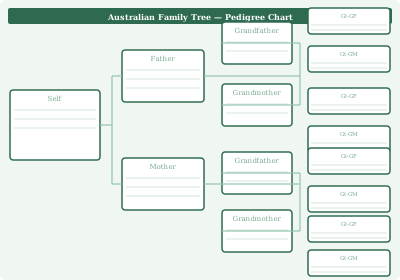
- Start with yourself in the leftmost column — record your full name, birth date, and State/Territory.
- Record birthplaces in the format used by Australian registries: Town, State/Territory (e.g. "Geelong, VIC" or "Hobart, TAS").
- Fill in parents and grandparents moving right across the chart.
- For great-grandparents who immigrated, note their country or region of origin in the Origin field.
About This Template
This Australian pedigree chart is a 4-generation ancestor chart formatted specifically for Australian family history research. The key difference from a standard pedigree chart is that birthplace fields use State/Territory labelling consistent with how Australian BDM (Births, Deaths and Marriages) registries record location. The great-grandparent column includes an Origin field — useful for the many Australians who have at least one great-grandparent born overseas, whether in England, Ireland, Scotland, China, Germany, or elsewhere.
For the majority of Australians, complete family history stretches back to the mid-to-late 19th century, when most states and territories began civil registration of births, marriages, and deaths. Using this chart alongside the state BDM registries — plus Trove for digitised historical newspapers — will allow most researchers to fill in three complete generations relatively quickly.
If you want to record more detail for each ancestor, pair this chart with a Family Group Sheet for each couple, and use the Australian Family History Research Checklist to track which record sources you have searched.
Australian Record Sources by Generation
- Parents and grandparents (born roughly 1920–1960). BDM certificates are the primary source. Most state registries offer online ordering. Electoral rolls are a useful supplement — federal electoral rolls from 1903 onwards are free to search via the National Archives of Australia (NAA).
- Great-grandparents (born roughly 1880–1920). BDM certificates are available but may require contacting the relevant state registry. Trove newspapers often contain birth notices, death notices, and obituaries. Electoral rolls cover this generation from 1903.
- Further back (born before 1880). Church registers become important — baptism, marriage, and burial records held by churches (Anglican, Catholic, Presbyterian, and others) predate civil registration in many colonies. The National Archives, state archives, and FamilySearch all hold relevant records.
Frequently Asked Questions
How is this different from a standard pedigree chart?
The Australian pedigree chart uses State/Territory fields rather than generic "Place" labels, and the great-grandparent column includes an "Origin" field for recording immigrant ancestors' country of birth. The subtitle also prompts researchers to record birthplaces in the format used by Australian BDM registries.
Which Australian records should I use to fill in this chart?
Start with BDM certificates from each relevant state: NSW BDM, VicBDM, Queensland Registry, SA BDM, BDMWA, Tasmanian BDM, NT BDM, or ACT BDM. Use Trove for older birth, marriage, and death notices in digitised newspapers. The Australian Family History Research Checklist on this site lists all major record sources.
How do I record a great-grandparent born overseas?
Record their birthplace as specifically as known — "County Cork, Ireland" rather than just "Ireland". Use the Origin field to note immigration details. Immigration records including assisted emigration records and ship passenger lists are held by the NAA and state archives.