How to Use This Template
- Open the template in your browser using the button above.
- Print in landscape orientation on A4 paper, or save as PDF.
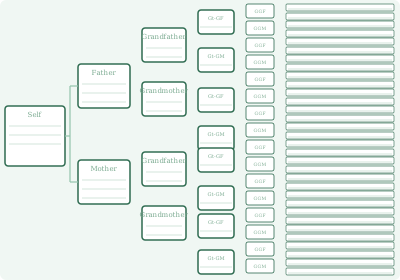
- Start with yourself in the leftmost column.
- Fill in parents, grandparents, great-grandparents, and great-great-grandparents moving right across columns.
- The final column contains your 32 great-great-great-grandparents — fill these in as your research progresses.
About This Template
The 6-generation pedigree chart extends the standard ancestry format to its practical limit on a single A4 landscape page. The chart records 63 direct ancestors across six columns, with each column doubling in population as you move right. The final column — your 32 great-great-great-grandparents — is necessarily compact, with space for names only. This template is designed for experienced genealogy researchers who have already completed their 5-generation chart and are actively pushing research further back.
Most genealogists reach the 6-generation boundary when researching ancestors born in the early 1800s, a period that coincides with the beginning of civil registration in England and Wales (1837), Ireland (1864), and much of mainland Europe. For Australian researchers, this era covers the early colonial period — 1788 to roughly 1840 — when convict transportation, free settlement, and early pastoral expansion were underway. Church baptism registers and colonial muster rolls are often the primary sources for this generation.
If your research is not yet at the 6-generation stage, start with the 4-generation pedigree chart or the 5-generation pedigree chart instead.
Frequently Asked Questions
How many people does a 6-generation pedigree chart show?
A 6-generation pedigree chart shows 63 direct ancestors: you, 2 parents, 4 grandparents, 8 great-grandparents, 16 great-great-grandparents, and 32 great-great-great-grandparents in the final column.
When should I use a 6-generation chart instead of a 5-generation one?
Use the 6-generation chart once your 5-generation pedigree chart is largely filled in and you have begun identifying great-great-great-grandparents. For most people these ancestors were born between approximately 1800 and 1840.
Where can I find 6th-generation ancestors?
Parish registers, early civil registration records, and digitised newspapers are the main sources for ancestors born in the early 1800s. For Australian research, Trove provides free access to colonial newspapers from this era. FamilySearch has free access to parish registers from the UK, Ireland, and Europe.